The News
- Details
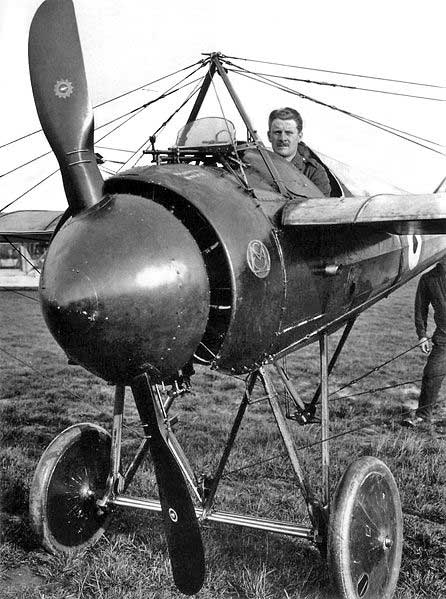
The fighter was born on April 1st, 1915. Roland Garros, a French pilot, got his first victory in the air with his Moraine Saulnier aircraft equipped with a forward firing machine gun, the first in history. Other planes had guns in the front, like the Vickers Gunbus, but they had gunners. The true effectiveness of the fighter wasn't achieved until a fixed gun was controlled by the pilot. He achieved this feat by attaching metal wedges on his propeller to deflect any bullets that might hit it. Within two weeks he was an ace. The solution he used was pretty hard on propellers, shattering some of them anyway. He was forced down later that month, and once Anthony Fokker saw his plane he quickly developed the interrupter gear that made the fighter into the ultimate killing machine of the air.
The United States have developed the ultimate fighters of modern times, the F-22 and the F-35, which can not only carry huge payloads, but get them there without being discovered by radar. However, even their reign will come to an end soon. Cheap computers and sensors will soon make their life miserable in the air, and their role will be to get some payloads in the air, to be released and hunt on their own, leaving the fighters to vacate the area as quickly as possible before they are hunted and killed by swarms of networked hunter/killer missiles.
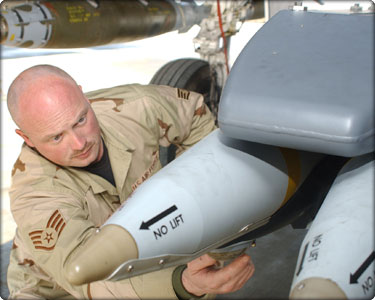
The US has been in this game for a while now, starting as long ago as 1998 with their LOCAAS or Low Cost Autonomous Attack System. This reduces the size of the warhead and makes it better to adapt to conditions on it's own, without any influence from the pilot of the aircraft carrying it. This system has already morphed into the SDB or the Small Diameter Bomb System. The system extends the standoff range, guides itself with GPS and INS (Inertial Navigation System), and also carries anti-jam and anti-spoofing modules. The size is smaller to reduce collateral damage, but it is still a killer, able to penetrate three feet of reinforced concrete. And if they are destroyed in the air, we lose no humans or expensive F-35's.
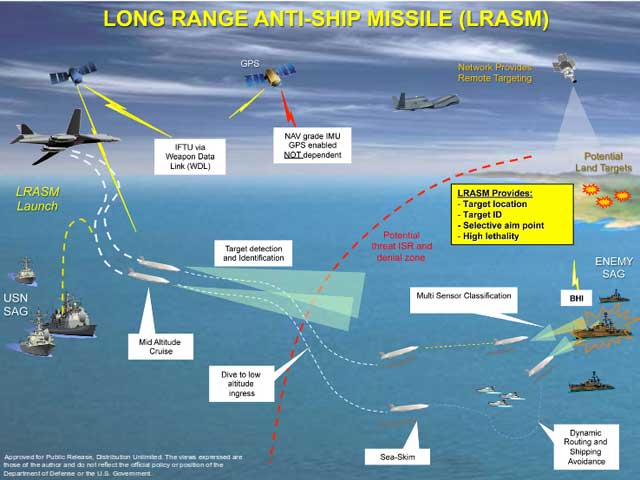
Another thing that will kill fighters will be the inability and cost to protect aircraft carriers. Other countries are developing weapons that will swarm the target, each equipped with different sensors and networked together, making a carrier quite a tempting target. It will be much cheaper to outfit a lot of Arleigh Burke class destroyers delivering the same ordnance, with smaller cross sections to attack. The US has developed the Long Range Anti-Ship Missile (LRASM) mostly because the Chinese already have better anti-ship missiles than we do. It has been successfully tested and has autonomously flew long range, identified and hit the target. On it's own.
Other countries may not be able to match the US's sophistication in these matters, but they are plenty capable of building autonomous systems on their own, and sometimes cheaper is better, as you can build lots more of them, potentially swamping the defense of a ship at sea. The aircraft carrier may not disappear, but like the battleship before it, it's time is almost up.
References
Birth of the fighter plane, 1915
- Details
Most of the 3D printed gun stories around the net are plastic things that are lucky to get a round off. One of those is a one shot wonder by Defense Distributed, and there is a rifle floating around called the Grizzly 2.0 that has fired several .22 caliber long rifle bullets, but none of them is something you'd go to war with. Now there is a gun you can take to battle, but it's not made on a cheap 3D printer out of plastic, but a commercial 3D printer using stainless steel sintered metal.
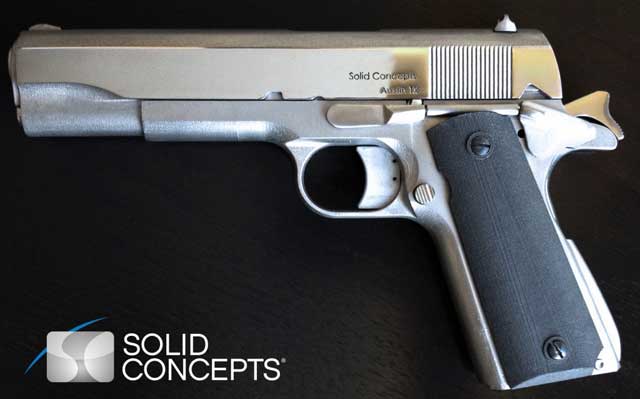
Solid Concepts 1911
It's built by Solid Concepts, and is a classic 1911 design. It's had 50 rounds through it so far, and the company says it's still in perfect shape, ready for more. They said they chose the design because it was in the public domain, but I think it was because it was a relatively simple gun which is quite robust. Even the barrel is printed (!) making 3D printing a new possible paradigm in gun manufacture. They say they can make parts much more accurate than machining, and much less porosity than investment cast parts. (This does suggest that there is much more porosity than machined steel...). Needless to say, Police departments and cities that are freaking out about 3D guns may really have something to worry about. However, printing a decent 3D gun is never going to be cheap, and doubtful that it will be in your basement anytime soon.
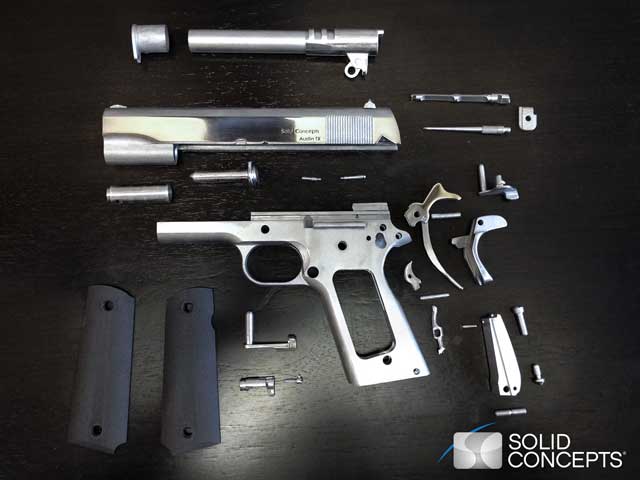
Nevertheless, Philadelphia isn't taking any chances. They have just banned 3D printed guns from the city.